Friday, June 26, 2015

How to financially survive a visit to an ER in the United States


I have a saying that has been proven to be true. "Catch someone at the wrong moment and they will appear to be an idiot."  Fortunately, this condition is rarely incurable.  It can be treated with training. That is, for specific situations, the proper response to given stimuli can be made to be almost automatic.  It's done for many situations from learning how to fight to learning how to perform first aid. Although its impossible to train for every situation there are several situations every American citizen should be prepared for.

When it comes to dealing with hospitals and ER (emergency room) treatment, disputing anything seems futile.  They seem to be massive organizations that have enough lawyers to crush most anyone.  Plus, a victim is close to the perfect customer.  The "customer"  usually doesn't know what is needed, has no idea what the costs are and may be in no condition to think rationally. 

But first, if you are in a condition to make a rational choice, some nasty expenses can be avoided before they happen. For example, if you find yourself facing a decision to take an ambulance ride to the ER (emergency room) or to an urgent care center keep these points in mind.
  • Consider that ambulance transport is between $400 to $1200 a ride and is not usually covered by insurance.
  • If you didn't call the ambulance, you don't need to take it! However, a "responsible person" such as a friend needs to accompany you away from the scene (and they will wait until this person shows up). 
  • If you do ride in an ambulance and you are conscious, you can choose your hospital. Although, if you are not in the best state of mind, that might be quite difficult due to shock.  Then again, if you ARE able to make a rational choice, what are you doing in an ambulance?  Regardless, prepare to be fleeced.  There's not much you can do about it except try to leave the hospital as early as you can and have as few billable incidents as possible.  The hospital will help shove you out.  They have a saying, "ship them out sicker and quicker"
  • For not so serious conditions an "urgent care" clinic might be a less expensive choice.  Just don't expect off-hour service or quick treatment.  Then again, I've noticed that ER rooms at hospitals are not that fast either.  What seems to be the main advantage of "Urgent care" places is that they are much more receptive to your concerns about exactly how much the treatment will cost. This is due to them frequently wanting up-front payment.
Ok, so you couldn't avoid a trip to the ER.  They stitched you up, put you in a cast, shoved you in a cab and you somehow crawled back in your home to recover.  At some point, you'll think about the the bills.   For normal debt it pays to retire debt as quick as possible to avoid interest and fees. However, hospital debt is rather strange. Ideally, a hospital would wrap all that hospital debt up for you.  Then you pay your percentage of whatever your healthcare plan covers, up to the out-of-pocket maximum.  However, that won't be what happens.

Instead of billing you immediately, the hospital may try to get an agreement with you as quick as possible (even though doing so may breech their contract with their insurance carriers). So, they will rarely contact you directly.  Instead, they may send you a big fat financial aid packet and/or use another organization call you to "ask questions" to see if you "qualify for help".  After a while, you'll  get a series of bills from labs, doctors, anesthesiologists and other specialists.  You'll also get duplicate bills, and invalid bills sometimes appearing MONTHS after treatment. Don't ever over pay anyone cause you'll NEVER get a refund.  So, unless you like needlessly tipping thousands of dollars to these people it's important that you don't pay anything early!  Instead, collect a pile of these bills.  Then, one by one, nicely go through them with your insurance company. I used to think a delay of a month was a long enough time.  However, after waiting a month, then paying all I thought I owed, I found I was getting billed again from the hospital!   Due to that, I recommend (and I'm not kidding about this) at least three months before paying bills. It's stressful, but I assure you it's less stressful than not having any money (or bargaining power) later! 
 
Here are some other tips:
  • Did I mention you should not pay anything as long as possible until YOU have the information required to get the maximum amount covered from your insurance company?  You can contact the people billing you to inform them of the delay.   To people billing you, make it clear that the delay isn't your fault but that your insurance company needs to review ALL claims, not just theirs.
  • Once you decide to process bills, contact your insurance company and ask them about EVERY bill no matter how small. Even if it needs to be paid, but isn't covered by insurance, at least it may eat away at your deductible.  
  • If anyone (but the hospital) says they will send you to a collection agency for non payment, inform them that the bill is being reviewed by your insurance company.  (make sure the insurance company really is reviewing it - ideally, giving you a correspondence number)  If they persist bothering you or threaten you with fees, remind them that charging additional interest or fees by itself may violate your insurance company's agreement with the hospital.  If they persist, offer to report them  to your states insurance fraud hotline.
  • Keep in mind, what is casually said over the phone usually applies to you, but unfortunately not to them. So, don't talk to anyone if you can help it. Instead, do it in writing if at all possible.
  • At some point, you'll then reach your "out of pocket maximum".  That is, the insurance company will pay 100% of what they cover.  However, you'll probably be responsible for a whole bunch of other stuff not covered - and that might make you go broke.  But hey, suck it up buttercup!  That's what you get for not doing enough to promote no-fault socialized medicine!
Hopefully, we'll soon get decent healthcare so you'll never need to go through all this.  However, if that doesn't happen, I hope these tips help.

Tuesday, July 29, 2014

Healthy lifestyles - according to my insurance company

Well, it's finally happened.  Just like the movie Sleeper, everything that was bad for you is apparently healthy and everything that was healthy is now bad.  At least, according to my insurance company.

Ok, so how does that work?  A long time ago, cigarettes were shown to cause cancer and fried food caused heart attacks.  Fortunately, most of the smoke I inhaled in college was from second hand smoke and I developed an aversion to fried food in college.  Then, I entered the working world.  I soon get sleep problems due to, well, showing up to work.  In order to stay alert, I start to drink coffee and caffeine loaded soda.  Also, with a horrible commute, there is no time for proper meals. So, my diet became horrendous. This makes my weight go up.  As my weight goes up, it causes night time breathing problems among other things.  Less sleep, more soda, coffee and salty snacks to keep me awake. Eventually, I have trouble breathing at night due to Apnea that I start falling asleep during the day.  You get the picture. 

So, I go to the doctor.  He prescribes a sleep machine and some medication.  I'm finally able to stay awake during the day and get sleep at night!  I feel better and stay in the working world. After 5 years of this routine, I move from one employer to another as the new career norm now demands.  During this time, I try to do my part. I lose some weight which allows me to only use the sleep machine as needed rather than as a full time dependency and taper down my medication. After several employers and several insurance company changes later, I find myself back with the original insurer who approved my original medication. My physical health didn't decline - but thanks to changing employers, my financial health did change.  What used to be a $15 prescription became $30,$75,$15,$0,$350 then $3000 - what? After going back to Blue Cross, they decide they now won't cover what they covered before.

I naturally ask why.  It turns out the medication and my sleep machine are now rather expensive items due to pharma inflation. So, the insurance company wants to look for an excuse to now deny me my continued use of both.  So, they had me report my sleep logs.   They finally say, "nope, sorry, you don't have enough usage hours on your sleep machine. So, we're not going to pay for a repair or replacement."  They were also very careful to say they weren't denying treatment.  Just payment.  No matter, the effect is the same.  Without replacements, I start gaining weight again which makes the condition worse.  Looking back, I could probably have fought it based on denying me based on a pre-existing condition.  However, now I've unfortunately demonstrated I'm not dead without these items.

Anyway, after years of not smoking, I'm considering doing it again to lose the weight (or at least arrest the gain).  It's a risk assessment.  An occasional cigarette saved my life during a critical period (say, driving in winter in the middle of nowhere when I HAD TO stay awake to find shelter).  In the same way, smoking in leu of excessive weight gain may have the same effect on me.  That is, weight loss (or at least slower weight gain) to get rid of the Apnea might be a greater benefit than the health lost to smoking. So, I'm well on my way to living the Woody Allen future as seen in the Sleeper movie. He noticed that not one person he knew eating a high fiber diet lived past 200. So, bring on the menthol butts and Mountain Dew! Thanks private insurance!

In all seriousness, what this shows to me is that in spite of Obamacare insurance reform, the a-la-carte way insurance companies can deny some medications and treatments to some people is a loophole the insurance/provider/pharma industries can fly a medivac helicopter through. Pharma can still sell it's overpriced medications to end users (some who will still pay those high prices, at least for a limited time). Hospitals can then offer treatment not approved by insurance at substantial markup (patients will either pay those extra charges or go bankrupt and generate writeoffs for the hospital). Doctors still get kickbacks from pharma companies by prescribing expensive non-covered medications that patients will still buy - at least for a limited time till they run out of money.  It's all very corrupt.  The very rich own medical stock, which is doing quite well.  The very poor (or those working in the growing underground economy) now benefit since they get basic medical treatment but have no income that qualifies for debt retirement garnishment.  Who pays for it?  A shrinking middle class (gradually turning into the working poor) that pay through inflated pre-tax insurance premiums and artificially inflated medical supply prices.

One wonders how long this can go on. Probably longer than I can.  Welcome to the future...

Tuesday, July 15, 2014

Pay off a mortgage or "invest" in the stock market

So, maybe you are living a little above the average "paycheck to paycheck" slobs.  You have a little extra money saved up, doing nothing In a savings account.  What should you invest in?  Should you pay off your home mortgage early or use that money to pad your retirement nest egg?  After reviewing several articles pro and con, I was not sure which way to go either. 


After reading articles, mostly pro-stock market investing, I opened a letter that absolutely decided the issue for me.  It was the check that I got which allowed me to “cash out” of one of my former employers 401K plans to my new employer’s 401K plan.  I compared the check amount I had to the statements I got in the months before.  Then compared it to the final “F##k Y#u" statement - that is the statement that says how much my fund would have been worth had I not cashed out.  During this long market rally, my fund value started at the year at 12k.  Then climbed to a little over 13K during March.  Then it would have apparently ended at just under 15K - that is, if I hadn’t cashed out a week earlier.  Yet, somehow between the statement printings that said 13K and 15K, the value at cash-out dropped to 10K? Coincidence?  Did a one-day massive stock drop then an even greater rally happen that week that nobody bothered to report on?  Of course not. The 10K what the mutual fund company deemed my paper was worth at that time. Since they were essentially the only buyer, well, they can really can set most any price they want.  In my case,  a technicality that allowed them to keep 1/3 of the stated value was a little condition buried in the fine print called "Forfeiture".

So, beware. There may be little mines in the fine print that allow these companies to legally not pay you anywhere near what you think you might get.  Also, keep in mind that mutual funds are subject to the same supply-demand that other investments are subject to.  That is, that gains or losses are only real the day of the sale.  The rest of the time, it’s statement bullshit to keep people in the market (see the blue dots that represent apparent values as per the quarterly statements).  I've named this phenomena “the sell-out curve”.  It’s not a real curve.  Rather, it’s the feeling one gets which seems like how the market must have performed the day of sell out when you get quite a bit less in a settlement check than the statements suggest you would get.  

Oh, and when it comes to retirement, there's another future whammy too.  Keep in mind 401K investments are pre-tax dollars.  So, when I finally decide to turn this next investment back into currency to spend, I still need to pay income tax on it too! 

So, what's a smarter investment? Getting rid of debt.  That includes home mortgage debt. I'll even go out on a limb and say "especially home debt". Do the compound interest calculation. A small interest rate over a long time is still a LOT of money. In fact, for many people, they pay twice the amount of dollars they pay for their home.  Yes, yes, inflation trends can create cheaper dollars. However, the trend for doubling one's wages is not encouraging.   Also, unlike an investment firm, most individuals cannot just decide to payback a bank less than the full stated amount owed.

Sunday, June 1, 2014

Got food? Modern day droughts.

Lots of attention has been directed to California's food producing problems - with good reason since the entire state is under a drought.  However, modern day water problems are not just in California.  Google "Kansas Dust Storm" and you'll see shocking footage of a modern day dust-bowl type storm that happened this spring 4-28-2014.  These weather events combined with the pending loss in reserve currency status (that would make food imports very expensive) may soon not only affect U.S. food prices but overall food availability.

Those that forget their history are doomed to repeat it.

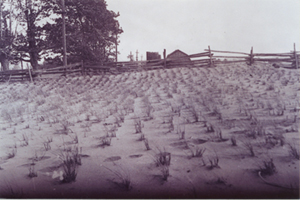
A combination of drought and misuse of marginal farmland led to Dust Bowl-like conditions in New York in the 1920s. Most people would think this photo came from somewhere in Kansas during the Dustbowl period in  the 1930's.  They would be wrong.  A combination of drought and misuse of marginal farmland led to Dust Bowl-like conditions in New York beginning in the 1920s.

Before the middle of the 19th century, forests had been primarily viewed as inexhaustible and an obstacle to civilization; they were something to be cleared out of the way for agriculture, or to be cut and exploited for profit. By the 1880s, less than 25% of New York State was forested, and the remaining uncut forests in the Catskills and Adirondacks were being logged fast. In 1885, New York created the Forest Preserve Act to protect state owned lands in the Catskills and Adirondacks from further exploitation. This act was strengthened in 1894 by an amendment to the New York State Constitution:

"The lands of the state, now owned or hereafter acquired, constituting the forest preserve as now fixed by law, shall be forever kept as wild forest lands. They shall not be leased, sold or exchanged, or be taken by any corporation, public or private, nor shall the timber thereon be sold, removed or destroyed."

Given that cultivated farmland will be reduced either through sensible legislation (such as in New York) or through natural forces (such as in Kansas) what is one to do?  One answer could be to encourage households to start kitchen gardens. A small plot of land, properly managed, has the potential to grow quite a bit of food.  Amateur gardeners can start with commercial seeds, soil and fertilizer for minimal investment.  Once the basics are mastered, permaculture techniques can then be gradually adopted.

Since back yards aren't available for everyone, other sources of food might be produced from basement or closet based hydroponic type systems.  One body of technology that may offer some promising solutions is the illegal pot growing industry.  Many "kits" needed to grow marijuana plans indoors can be easily adopted to growing other crops such as tomatoes.  Ironically, the patent laws might soon make growing any plant from seed be something that is just as much a criminal offense as growing pot from seed now is.  Given the potential for profitable shakedowns for those who dare save seeds, the ability to grow plants covertly may eventually be of some benefit.

Friday, July 12, 2013

Selective enforcement

For years in the U.S. there has always been the problem of selective enforcement when it comes to laws.  There are numerous times where one person is made into an "example" by being assigned a penalty while others get none. My favorite example is issuing speeding tickets. Speeders could easily have on-the-spot convictions at toll booths with time stamped tickets but they never are due to that pesky right to a fair trial requirement. In my opinion, it shouldn't prevent at least an appearance ticket from being issued if early payment of a toll shows speeding. However, I digress.

The fact is, the individual has more laws than can be applied to them than can be read in a human lifetime.  Does the fact a person can unknowingly break several  laws a day lead to frequent incarceration?  In most cases, no.  Instead, it leads to unelected governance and government bloat such as this team of agents who used taxpayer dollars to do a multi-agent arrest of a girl for buying water.  Why? The rulers become the ones who know the rules and can pick and choose which ones to point out when it's convenient to do so.  Such people include IRS auditors, coding inspectors, police officers and anyone else who has any government regulatory power at all.  Those who flash badges can even make up laws to entrap people such as officers in Ohio who set up a fake drug checkpoint.  Also, check out how our own FBI is "inventing terrorists"  It makes one wonder why we have laws at all. 

One relatively new use of selective enforcement is now being done to increase profits in the medical industry.  Did you know stockpiling your own medication is now illegal? Yes, stockpiling more than the prescribed dose of critical medication, you may need to live, is illegal. So, if you pill split due to anticipating a shortage due to financial hardship, too bad! Its more than you need since you obviously can get by with the lower dosage.  So, it could be the slammer for you!

Oh, but it gets better.  Suppose you check the price of your prescription with your pharmacist.  In some cases, the price charged is much higher than if you had no insurance at all!    However, going to another pharmacy and state you have a prescription and want to pay cash since you have no insurance.  Doing that is ...you guessed it...illegal.  Sorry, you were stupid enough to sign up for a medical plan through your employer that you cannot opt out of unless you are fired.  So, if you can't afford the higher price and you won't quit your job to get the lower price...no medicine for you!

When it comes to prescription drug laws, they now exist to extract maximum profit from patients.   Due to selective enforcement, these laws are making poorer people needlessly miserable.  Since rich people can still get drugs (and poor people know it) there is also collective non-respect for ALL laws gradually developing. Furthermore, a very lucrative price support system is now in place that is encouraging organized crime to enter the medical field.

For example, one area that is experiencing explosive growth is in heroin distribution in leu of prescription pain killers.  The pattern is very simple to see. a person gets hurt.  Person is prescribed very powerful prescription pain killers.  Medication is then abruptly stopped either due to further prescriptions not being issued or more often insurance refusing to pay for drugs being sold at inflated prices.  Person is then addicted and/or is still in excruciating pain.  Result?  Person is willing to do almost anything to get release from the pain.  At first, they pay the inflated drug prices.  Once they are out of money (and it doesn't take long since self-pay prices may be in the thousands per dose), they then turn to illegal but affordable alternatives such as heroin. Pain is enough of a motivator to them that they not only overcome their fear of dealing with very scary people but also overcoming a very powerful natural aversion to needles to self-inject heroin into their bodies.   

The solution to any corrupted system isn't easy.  It's just this:  Replace our elected incumbents with people who are willing to repeal laws that may only exist to perpetuate the profits of a few at the expense of many.  The alternative will be to enter into a world where the official economy becomes crippled by provisional governance while an alternate system immune from regulation or taxation (and usually prone to violence) will start to thrive.

Monday, May 27, 2013

This memorial day, here's to those in the silent service.

No, I'm not referring to those in the NAVY who served in submarine service or even the field agent spooks who worked for the FBI. Rather, I'm talking about the millions of non-government employees who go to work every day to generate the wealth to make a military possible. They are the factory workers, hotel cleaners, food service workers, retail people, nursing home workers, tomato pickers, forklift drivers and countless others who provide support services but have not directly served in one of the armed forces.


These civilians forgo a lifetime of benefits and status of government service to provide the true wealth that allows the rest of our government to function. They are the ones who do without civil or military pensions.  They get no extra points on civil service tests or special tax breaks.  They get no veteran discounts and would be quickly dragged out of a VA hospital if they were sick in spite of possibly having been employed at one.

So, here's to all the tax payers in private industry who actually work for a living. It's OK to appreciate the servicemen but don't forget everyone else who made their job possible.

Sunday, March 10, 2013

The peacemaker of our time.

I was listening to the radio about how crime has mysteriously decreased in some cities.  Of course, some agencies are quick to take credit for this.  From Homeland Security and New York City police to the Prison Industrial Complex, all are quick to take credit for a reduction in crime.  However, I suspect something else is at work that has little to do with the boondoggle efforts of bloated police forces or even the number of guns in the hands of civilians.

Years ago, I was reading a Tom Clancy novel, Red Storm Rising.  It was a  novel about the Russians doing a bolt from the blue attack and being thwarted.   One statement that made the story more interesting was about how it was done.  A particular sergeant who somehow survived a surprise assault by the Russians was overrun and became trapped behind enemy lines.  He fortunately had, in the words of Tom Clancy, "one of the most powerful weapons in the U.S. military".  No, it wasn't a backpack nuke.  It was simply a radio.  He then proceeded to call in air strikes, artillery and other nasty countermeasures that ultimately stopped the assault.

In a similar way, most people (even children) now have that capability.  It exists in the form of a cellular telephone.  These little devices have an emergency number 911.  Thanks to that number, any incident can now be quickly reported.  When an incident is reported, resources start going to the site of the call. Even if the perpetrators left the scene, it's likely somebody may have recorded the event on a phone camera. Depending on what was reported or recorded, firemen, police, ambulances, helicopters, national guard units and even regular army could be called in until the threat is addressed. What is the difference today versus 20 years ago?  Is it bigger, better faster fire trucks? Is it due to some super breed of airport security guard? No, it's simply more information from any given incident.

With the emergence of phone cameras and GPS, the environment in the United States isn't very private. We already live in a virtual police state where movements are tracked.  It's a world where speeding tickets are issued by machines and mailed to the car owner.  It's a society where photos can be taken out of context for wrongful convictions (For example, speeding tickets for people who own the car versus drive the car).  It's also becoming a world where neighbors are encouraged by society to inform on other neighbors and where children inform on their parents.  In trade, we have a world where petty crime is less common but where minor incidents often are punished to the full extent of the law. It's also a world where Google can give the appearance of significantly boosting  IQ but lack of that data crutch can be crippling. It's the old choice of freedom from versus freedom to.

Some say this world of complexity will someday fail suddenly.  I disagree.  I expect that some version of mobile-data will be maintained in all but the worst energy depletion scenarios.  I base this on the fact that various 3rd world areas with sketchy economies still manage to provide surprising levels of cellular service over relatively barren areas.  Given that, is almost ubiquitous connectivity worth the trade of living in a surveillance state? That choice for now is still up to the individual.  Leaving the mobile phone at home or pulling out the battery (or just not charging it) is still an option. \

Sunday, February 24, 2013

The trial never ends

I decided to try to take a break from thinking of Peak Oil and resource depletion issues. So, I decided to watch an old episode of Star Trek. In the episode I was watching, a member of a race of ultimately powerful beings, the "Q", decided to test the main character of the program to see if he was worthy of continued existence. At the end of the trial, in the episode "All Good Things", the main character "Capt. Picard" found he managed to not only save his ship and crew but all of humanity as well. At the end, the dialog shows us some life lessons that i suspect apply to us all.

Picard: "I sincerely hope this is the last time I find myself here". (Talking to "Q" at the trial site, after successfully passing his latest challenge)

Q: "You just don't get it do you. Weren't you listening? The trial never ends! We wanted to see if you had the ability to expand your mind and your horizons...For one fraction of a second, you were open to options you had never considered. That's the exploration that awaits you. Not charting stars and studying nebulae but charting the unknown possibilities of existence..."

It really put my daily (and future) challenges due to Peak Oil into perspective. The trials(s) never really do end do they? Even if such tests aren't administered by an ultimately powerful being, we each encounter hundreds of choices each day. From crossing a street to choosing a good breakfast, they have eventual consequences through time that may ultimately ensure our continued existence or our destruction. This happens on the dullest of days or during days full of obvious survival challenges. So, each day is important. Not just for the choices it brings but for being a step towards occasionally being put in a position to make important choices about our existence.

Saturday, February 16, 2013

Budget Buster

.
I finally thought I figured it out.  I stabilized my rent by getting a relatively small house with a fixed rate mortgage. (which also means small property taxes). That made my monthly housing costs average around $500/mo. plus upkeep.  I reduced my transport costs by taking the bus to work.  My heating bills stay low by turning my home down to 50F during the winter and I've converted to CFL lights.  I also garden in the summer.  To keep the water bills down, I take showers at the health club (inconvenient, but it keeps me fit and does save money). When I'm home, I walk or bike virtually everywhere.  One nice side effect is that I'm loosing weight.   I gave up CATV and a home phone years ago. For my mobile phone and Internet (required for my job) I'm relying on cellular service.   Until recently, I even managed to save a bit.  Not enough for retirement but enough for an occasional emergency.

That is, until I signed up for health insurance.  The good news was that I got it.  However, the bad news was that it was a budget buster. In spite of making roughly 1/3 more per hour from last year, my budget would not balance!   So, I decided to look at why.  It was really simple.  My healthcare premiums exceed what I would pay for a nice car or a mortgage payment for a much larger house.  For this, I get the chance of not going absolutely broke if I get hurt. Unfortunately, I'm not alone in my struggle to stay in the middle class.  If you are struggling too and wondering why, you may want to look at this video that puts some of these changes into perspective.


The coming collapse of the middle class


Sunday, February 10, 2013

An alternative way of doing business

There seems no alternative to cash....or is there? Depending on who you pay tax to, it may be possible to either pay taxes with items or at worst sell items for cash. It may be possible to barter for payment of taxes. The principle is based on this article which showed how one individual turned one red paperclip into a house through a series of creative trades. Now, the article is not to show that you simply need a drawer full of paperclips to solve your financial needs. Rather, it's to show how it may be possible to buy and sell items until there may be an item the local government needs that could be used as payment in leu of taxes.

Bartering isn't about living without working or even sponging off the government. Rather, it is a way of directly participating in the economy. Although there are significant problems with keeping the government out of transactions, bartering can still be remarkably profitable and efficient.

As a thought experiment, I had the idea of comparing a bartering operation (or one that uses cash in small non-traceable units of currency) versus setting up a static business location that processes all it's transactions tracked with the help of a bank. Here are just some of the costs the bartering operation could evade.
  • Income tax (Federal, State and sometimes local)
  • Sales tax
  • Business license or permits
  • Mandatory insurance (workers comp, unemployment, other liability insurances)
  • Employer's share of social security
  • Employer provided benefits such as health care plans
  • Credit card transaction fees and commercial bank fees
  • Cost increases for various services due to paying "business rates" rather than "consumer rates".
  • Cost of accounting in time/money for simply complying with U.S. tax laws.
The last item, in my opinion, is perhaps the highest cost. It's not the money collected. Rather, it’s the cost of compliance. The simple fact is, when the cost of evasion becomes lower than the cost of compliance then individuals and businesses start changing over into System-D economic systems or Gift Economies.

So, in my opinion, if Federal and State governments want to realistically look at restoring their economy by restoring their tax revenues, they need to look at reducing the cost of compliance for micro businesses. For example, State and Federal governments may want to offer an alternative simple "safe haven" tax on gross receipts. Then, as the new business becomes more successful and can afford more complexity, the business owners could pick a later year to start itemizing using the current rules. Once a business is large enough to hire enough employees to handle the complex rules. Finally, it might be able to provide lots of employment and then evade many of those pesky taxes as these large businesses did.  However, income tax, sales tax and other fees from employees usually makes up for lost corporate taxes. Why do you think politicians want jobs, jobs, jobs!

But isn’t there another way? Do towns and cities always need to resort to corporate giveaways just to make their budgets work?  How about encouraging residents to form micro businesses instead?

Here's a practical micro-business idea. Encourage land owners to host flea markets. Each person pays a flat rate to the land owner for retail space for the day. Plot prices would be posted so Each plot renter can decide if selling stuff for a fee is worth their while. If they do, they rent a plot for a day. The retail space vendor then pays a share of the rental fee to sales tax people. The vendors who do this would not need to keep track of sales taxes (or even income tax). Just turn in (or mail) a check for the days receipts. Audits would be easy - just count spaces & multiply by a percentage of plot price. If a vendor charges too little for each plot, the vendor and taxman miss out on profit and tax revenue. Charge too much, they both miss out due to lack of spaces being sold. Charge just right, and a thriving market can happen.

Lessons learned from "The Colonly"

I'm not usually a fan of "reality" shows but I am making an exception for the Discovery Channel series "The Colony". Usually, I find "reality shows" are either incredibly staged or simply boring. The series "The Colony" fits more into the "staged" category. The participants were given the scenario that they were experiencing the downfall of civilization due to a viral plague and were provided a temporary sanctuary in a former factory. There, they were given some supplies, tools, materials and an opportunity to try to not only survive but rebuild a piece of civilization.

Although the show had several do it yourself tricks to solving problems the first season reminded me of the 80's series, the "A-Team." In that series the heros were usually "trapped" somewhere that just happened to be a fully stocked machine shop. They would happen to have enough time, knowledge and materials to build something impressive such as an armored car that they would use to defeat bad guys with. In spite of the first season looking like a giant Harbor Freight machine tool commercial, there were some useful lessons to be learned. For example, a sand-charcoal-boiling water purification is a neat trick (just don't forget to boil the water). The emphasis on water systems also had another surprise for me. I knew the importance of health when it came to drinking water and showers in addition to a wastewater system. However, it looks like a pedal powered washing machine could be a surprisingly important device for anti-septic practices too. The projects of building a spark-gap radio, Tesla coil and wood gassifier truck were a bit far fetched but the projects kept the show interesting. The observations by the "experts" on social interactions were useful too.


In my opinion, the biggest problem was the existence but non-interaction with the camera people. For example, it was a bit hard to convince the viewer of a stealthy night action with a guy trailing behind with a big-ole camera light on! That problem might have been overcome with more static placed cameras. Then again, the cinema photography might start resembling the extremely boring "big brother" series. What might have been interesting would have been if cameras were used like the series "Survivorman". That is, the participants would manage their own cameras. Then again, it might then lead to many of the truly interesting scenes being lost. I can imagine the dialog during a crisis scene... "Hey, stop F***ing with your camera and help me fight!"

Second, the simulation assumed an apparent non-existence of working guns. The only people who had guns were some trading nomads who could have easily taken everything the group had. None of the rogues had guns but did have lots of fuel for running noisy motorcycles. Of course, just one bad guy with a working firearm on either side would have distorted the social dynamic sufficiently to make every participant simply fortify in their respective buildings. That's where the boring part comes in. Laying siege to a place may take weeks with no real action.

It's also rather depressing that the participants decided that fighting, scavenging then finally fleeing were the winning criteria. It would have been much more interesting to develop secure localized production of something and restore a piece of a local economy. Instead, in both seasons, the emphasis seemed to be to simply fortify a camp, fight some neighbors then build an "escape" vehicle to go somewhere else. Such a strategy might work in a very small disaster. However, that's no way to go about rebuilding civilization!

I do give kudos to the director who realized this and decided to show a brief scene at the very end of the second season to dispel the idea that fleeing is always the best option. The last scene was where the survivors make it to their destination on their home built vehicle only to find - more desperate hungry people! In fact, I was surprised that there was little debate about the validity of a radio transmission which claimed lots of food, utilities and other survivors. That kind of transmission could easily have been a trap set by another survivor group!

However, even with it's faults, I think the series is worth a watch. It has  numerous observations about human nature under various situations along with some technical tips. While it's no instruction video, it's a good jump point to investigating possible methods, procedures and devices that might be handy in a disaster (hint: try the solutions in a non-crisis situation BEFORE you assume they are practical). If nothing else, the series will probably make you not wish for a crisis at all and try harder to maintain the civilization you have now!

Sunday, November 25, 2012

Improve it till it sucks, why it happens - part two

Finding why things suck is important in a world of resource depletion. Our society has become accustomed to generating large amounts of waste and one of the sources is from products and services that no longer work properly. In the years ahead, we will no longer be able to absorb large amounts of wasted materials and effort. So, with that, let's look at one cause of why stuff sucks today. One cause can be due to the marketing cycle itself.

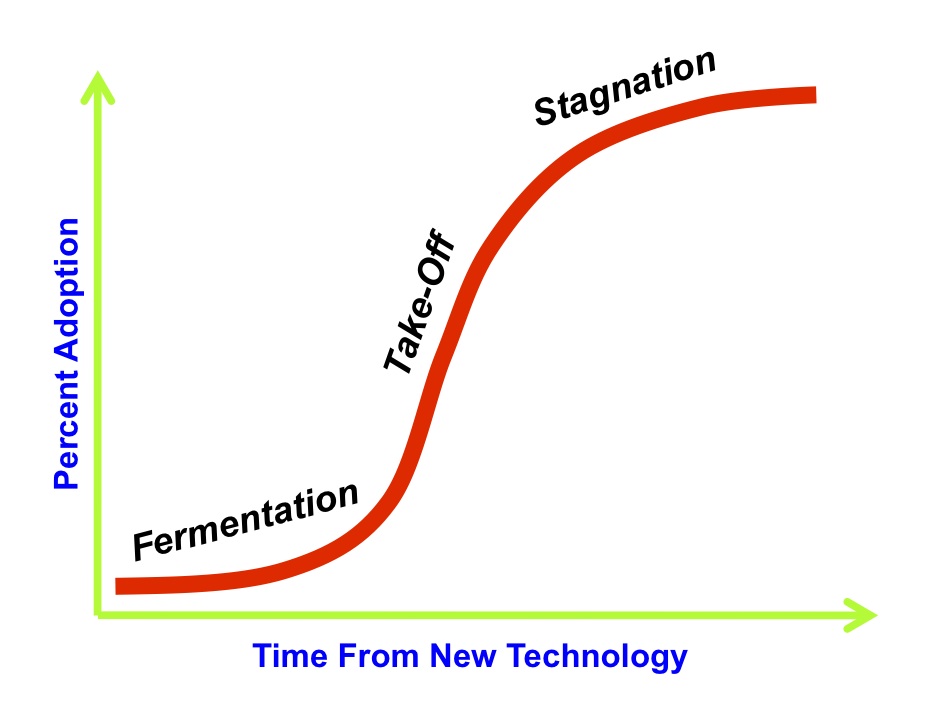
When it comes to the marketing cycle of products or services, most marketing text books show products tend to roughly follow an "S" curve similar to the one below.
The fermentation stage is where the first product or service gets test marketed and finally sold. Once it's clear the product or service can fulfill a legitimate demand, production goes up and there is usually an attempt to reduce costs. Some improvement attempts, such as buying component parts in larger quantities which can be produced and shipped with more efficient methods, will reduce unit cost without reducing the quality of the product. Some statistical based production methods, that can only be employed with large production quantities, may even improve the quality further. As the market gets saturated and competitors enter the market, the "stagnation" stage starts. At this point, the product or service is usually "value engineered" to increase profitability at the cost of quality. For example, durable metal parts may be replaced by weaker or less precise plastic parts to match the price of competitors.

The next reason things can suck, which is to my knowledge has never been mentioned in business textbooks, is cultural. At the stagnation stage, the corporation has been accustomed to high growth and fat margins. So to keep operating, it needs a way to either increase revenue or lower costs. Perhaps debt servicing requires high growth or maybe management is just used to paying themselves well. If those expenditures cannot be reduced, management naturally then looks to reducing other costs and there's usually no larger cost than employees.  It is at this point that employees try to justify their existence in some way. This is where the product enters what I would call the "improve it till it sucks" phase. Rather than be satisfied with offering products that do their essential job well, employees propose new non-essential features, sales gimmicks and "improved" interfaces to promise sales levels and cost levels that will keep management happy.

The number of ideas people come up with to keep their jobs is truly amazing. This is especially true if salaried positions are decoupled with sales results. When this is the case, the "customer" often becomes upper management rather than people outside the company. Perhaps this is why websites often introduce "new and improved" features that cannot be accessed by anything except the latest web browsers or newest mobile devices (often operated by management). Other changes may lead to shorter product life which may force upgrades or repeat sales in the short term.   These changes, presented as "improvements", are what I would call the "keep your boss happy" product changes.  They keep the boss happy but not the customer.   This can be most easily seen in software where later versions either have feature encrustation or dumbed-down functionality in order to monetize a formerly free offering of features.

The customer can also be at fault too when it comes to demanding value from purchases.  I suspect this is may be due to the cultural quest for seeking items that are "new" or "different" or it may just be due to declining per-capita wealth.  Lack of demand for quality may also be due to the fracturing of traditional families which prevents high quality items from being passed down from generation to generation. This is not to say the demand for high quality items has vanished.   Most people want  items that perform well over many years.  However, there is a significant risk to the customer for paying a premium for such items.  It is all too tempting for a manufacturer to offer an item that appears higher quality, but really isn't.  Perhaps all this is why, as my grandfather said, "You get what you pay for - only if you're lucky."

Monday, November 12, 2012

Improve it till it sucks, why it happens - part one

A long time ago in a career far-far away, I was once asked this question by my electronics store sales manager... He first told me, "Look around. Look at all the items in this store. Why are these particular items here?" I looked at the various items in the store. There were quite a variety with each having some utility but with almost no common use that I could see.
So, wondering where he was going with that question, I told him I had no idea. His reply was loud but direct, "THEY ARE HERE TO BE SOLD!". It was at that point when I finally truly understood the reasoning behind the apparent stupidity of some products. It now made sense why some of the higher priced radios sounded the same as the lower priced units with the only difference being that the higher priced unit had more functionally useless plastic parts stuck on them. It was the same reason some radios had excessive glowing lights, and LCD displays which looked high-tech but added virtually nothing to the music but were fetching higher prices than neighboring items on the shelf. I realized that the product designers simply wanted to maximize money. If it caused radios to become more ornate to sell better, so be it.

To multinational corporations, products are only useful as devices for which money is gathered. They have little sense of trying to make the world a better place. Rather, they are ultimately governed by stockholders and the legal requirement to make as high of a return for capital invested as possible. They care not if they sell round radios, yellow airplanes or square apples. As long as the items make money they are considered a success! In extreme cases, if an item is useful, it's almost a side effect. In many cases, the requirement of being useful isn't needed at all. Witness a fad from the 1970s called the pet rock.


The next piece of the puzzle, which I have never seen mentioned in any textbook, is another reason why so much stuff tends to improve till it sucks. When taken with this posting, it explains much.
See  part two.

Sunday, October 21, 2012

"Just stop it" - one of the better memes.

When it comes to ideas that address such issues as Peak Oil and Global Climate Change, it's often not so much about a few individuals coming up with profound ideas as it is about filtering memes. For those who don't know what a meme is, it's simply an idea or saying that propagates and multiplies in a similar way that a life form does. In fact there is a series that examines how memes propagate. But I digress.

I would like to concentrate on one particular meme that I suspect could be a solution to many of the social ills which manifest themselves during times of stress. I could not have had a better introduction to the concept than was expressed by Linda Easley of the blog site "The conflicted doomer".

"There are times when I look around at what’s going on in the world and feel certain that aliens have invaded us, sucked out the brains of much of the world’s religious population and replaced it with grape jelly or something while I was out working in the garden."

In spite of many individuals apparently undergoing this transformation as we experience the transformation of traditional industrial civilization, there is hope. One of the solutions to address the temporary stupidity afflicting some individuals, especially during elections, is the "Just stop it" meme. Hopefully, that meme will gain in popularity just as the various resource and environmental depletion memes have done.