So, here's to all the tax payers in private industry who actually work for a living. It's OK to appreciate the servicemen but don't forget everyone else who made their job possible.
Monday, May 27, 2013
This memorial day, here's to those in the silent service.
No, I'm not referring to those in the NAVY who served in submarine service or even the field agent spooks who worked for the FBI. Rather, I'm talking about the millions of non-government employees who go to work every day to generate the wealth to make a military possible. They are the factory workers, hotel cleaners, food service workers, retail people, nursing home workers, tomato pickers, forklift drivers and countless others who provide support services but have not directly served in one of the armed forces.
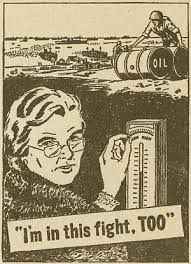 These civilians forgo a lifetime of benefits and status of government service to provide the true wealth that allows the rest of our government to function. They are the ones who do without civil or military pensions. They get no extra points on civil service tests or special tax breaks. They get no veteran discounts and would be quickly dragged out of a VA hospital if they were sick in spite of possibly having been employed at one.
So, here's to all the tax payers in private industry who actually work for a living. It's OK to appreciate the servicemen but don't forget everyone else who made their job possible.
So, here's to all the tax payers in private industry who actually work for a living. It's OK to appreciate the servicemen but don't forget everyone else who made their job possible.

Sunday, March 10, 2013
The peacemaker of our time.
 I was listening to the radio about how crime has mysteriously decreased in some cities. Of course, some agencies are quick to take credit for this. From Homeland Security and New York City police to the Prison Industrial Complex, all are quick to take credit for a reduction in crime. However, I suspect something else is at work that has little to do with the boondoggle efforts of bloated police forces or even the number of guns in the hands of civilians.
Years ago, I was reading a Tom Clancy novel, Red Storm Rising. It was a novel about the Russians doing a bolt from the blue attack and being thwarted. One statement that made the story more interesting was about how it was done. A particular sergeant who somehow survived a surprise assault by the Russians was overrun and became trapped behind enemy lines. He fortunately had, in the words of Tom Clancy, "one of the most powerful weapons in the U.S. military". No, it wasn't a backpack nuke. It was simply a radio. He then proceeded to call in air strikes, artillery and other nasty countermeasures that ultimately stopped the assault.
In a similar way, most people (even children) now have that capability. It exists in the form of a cellular telephone. These little devices have an emergency number 911. Thanks to that number, any incident can now be quickly reported. When an incident is reported, resources start going to the site of the call. Even if the perpetrators left the scene, it's likely somebody may have recorded the event on a phone camera. Depending on what was reported or recorded, firemen, police, ambulances, helicopters, national guard units and even regular army could be called in until the threat is addressed. What is the difference today versus 20 years ago? Is it bigger, better faster fire trucks? Is it due to some super breed of airport security guard? No, it's simply more information from any given incident.
With the emergence of phone cameras and GPS, the environment in the United States isn't very private. We already live in a virtual police state where movements are tracked. It's a world where speeding tickets are issued by machines and mailed to the car owner. It's a society where photos can be taken out of context for wrongful convictions (For example, speeding tickets for people who own the car versus drive the car). It's also becoming a world where neighbors are encouraged by society to inform on other neighbors and where children inform on their parents. In trade, we have a world where petty crime is less common but where minor incidents often are punished to the full extent of the law. It's also a world where Google can give the appearance of significantly boosting IQ but lack of that data crutch can be crippling. It's the old choice of freedom from versus freedom to.
Some say this world of complexity will someday fail suddenly. I disagree. I expect that some version of mobile-data will be maintained in all but the worst energy depletion scenarios. I base this on the fact that various 3rd world areas with sketchy economies still manage to provide surprising levels of cellular service over relatively barren areas. Given that, is almost ubiquitous connectivity worth the trade of living in a surveillance state? That choice for now is still up to the individual. Leaving the mobile phone at home or pulling out the battery (or just not charging it) is still an option. \
Sunday, February 24, 2013
The trial never ends
I decided to try to take a break from thinking of Peak Oil and resource depletion issues. So, I decided to watch an old episode of Star Trek. In the episode I was watching, a member of a race of ultimately powerful beings, the "Q", decided to test the main character of the program to see if he was worthy of continued existence. At the end of the trial, in the episode "All Good Things", the main character "Capt. Picard" found he managed to not only save his ship and crew but all of humanity as well. At the end, the dialog shows us some life lessons that i suspect apply to us all.

Picard: "I sincerely hope this is the last time I find myself here". (Talking to "Q" at the trial site, after successfully passing his latest challenge)
Q: "You just don't get it do you. Weren't you listening? The trial never ends! We wanted to see if you had the ability to expand your mind and your horizons...For one fraction of a second, you were open to options you had never considered. That's the exploration that awaits you. Not charting stars and studying nebulae but charting the unknown possibilities of existence..."
It really put my daily (and future) challenges due to Peak Oil into perspective. The trials(s) never really do end do they? Even if such tests aren't administered by an ultimately powerful being, we each encounter hundreds of choices each day. From crossing a street to choosing a good breakfast, they have eventual consequences through time that may ultimately ensure our continued existence or our destruction. This happens on the dullest of days or during days full of obvious survival challenges. So, each day is important. Not just for the choices it brings but for being a step towards occasionally being put in a position to make important choices about our existence.
Picard: "I sincerely hope this is the last time I find myself here". (Talking to "Q" at the trial site, after successfully passing his latest challenge)
Q: "You just don't get it do you. Weren't you listening? The trial never ends! We wanted to see if you had the ability to expand your mind and your horizons...For one fraction of a second, you were open to options you had never considered. That's the exploration that awaits you. Not charting stars and studying nebulae but charting the unknown possibilities of existence..."
It really put my daily (and future) challenges due to Peak Oil into perspective. The trials(s) never really do end do they? Even if such tests aren't administered by an ultimately powerful being, we each encounter hundreds of choices each day. From crossing a street to choosing a good breakfast, they have eventual consequences through time that may ultimately ensure our continued existence or our destruction. This happens on the dullest of days or during days full of obvious survival challenges. So, each day is important. Not just for the choices it brings but for being a step towards occasionally being put in a position to make important choices about our existence.
Saturday, February 16, 2013
Budget Buster
I finally thought I figured it out. I stabilized my rent by getting a relatively small house with a fixed rate mortgage. (which also means small property taxes). That made my monthly housing costs average around $500/mo. plus upkeep. I reduced my transport costs by taking the bus to work. My heating bills stay low by turning my home down to 50F during the winter and I've converted to CFL lights. I also garden in the summer. To keep the water bills down, I take showers at the health club (inconvenient, but it keeps me fit and does save money). When I'm home, I walk or bike virtually everywhere. One nice side effect is that I'm loosing weight. I gave up CATV and a home phone years ago. For my mobile phone and Internet (required for my job) I'm relying on cellular service. Until recently, I even managed to save a bit. Not enough for retirement but enough for an occasional emergency.
That is, until I signed up for health insurance. The good news was that I got it. However, the bad news was that it was a budget buster. In spite of making roughly 1/3 more per hour from last year, my budget would not balance! So, I decided to look at why. It was really simple. My healthcare premiums exceed what I would pay for a nice car or a mortgage payment for a much larger house. For this, I get the chance of not going absolutely broke if I get hurt. Unfortunately, I'm not alone in my struggle to stay in the middle class. If you are struggling too and wondering why, you may want to look at this video that puts some of these changes into perspective.

That is, until I signed up for health insurance. The good news was that I got it. However, the bad news was that it was a budget buster. In spite of making roughly 1/3 more per hour from last year, my budget would not balance! So, I decided to look at why. It was really simple. My healthcare premiums exceed what I would pay for a nice car or a mortgage payment for a much larger house. For this, I get the chance of not going absolutely broke if I get hurt. Unfortunately, I'm not alone in my struggle to stay in the middle class. If you are struggling too and wondering why, you may want to look at this video that puts some of these changes into perspective.
The coming collapse of the middle class
Sunday, February 10, 2013
An alternative way of doing business
There seems no alternative to cash....or is there? Depending on who you pay tax to, it may be possible to either pay taxes with items or at worst sell items for cash. It may be possible to barter for payment of taxes.  The principle is based on this article which showed how one individual turned one red paperclip into a house through a series of creative trades. Now, the article is not to show that you simply need a drawer full of paperclips to solve your financial needs. Rather, it's to show how it may be possible to buy and sell items until there may be an item the local government needs that could be used as payment in leu of taxes.
Bartering isn't about living without working or even sponging off the government. Rather, it is a way of directly participating in the economy. Although there are significant problems with keeping the government out of transactions, bartering can still be remarkably profitable and efficient.
As a thought experiment, I had the idea of comparing a bartering operation (or one that uses cash in small non-traceable units of currency) versus setting up a static business location that processes all it's transactions tracked with the help of a bank. Here are just some of the costs the bartering operation could evade.
So, in my opinion, if Federal and State governments want to realistically look at restoring their economy by restoring their tax revenues, they need to look at reducing the cost of compliance for micro businesses. For example, State and Federal governments may want to offer an alternative simple "safe haven" tax on gross receipts. Then, as the new business becomes more successful and can afford more complexity, the business owners could pick a later year to start itemizing using the current rules. Once a business is large enough to hire enough employees to handle the complex rules. Finally, it might be able to provide lots of employment and then evade many of those pesky taxes as these large businesses did. However, income tax, sales tax and other fees from employees usually makes up for lost corporate taxes. Why do you think politicians want jobs, jobs, jobs!
The principle is based on this article which showed how one individual turned one red paperclip into a house through a series of creative trades. Now, the article is not to show that you simply need a drawer full of paperclips to solve your financial needs. Rather, it's to show how it may be possible to buy and sell items until there may be an item the local government needs that could be used as payment in leu of taxes.Bartering isn't about living without working or even sponging off the government. Rather, it is a way of directly participating in the economy. Although there are significant problems with keeping the government out of transactions, bartering can still be remarkably profitable and efficient.
As a thought experiment, I had the idea of comparing a bartering operation (or one that uses cash in small non-traceable units of currency) versus setting up a static business location that processes all it's transactions tracked with the help of a bank. Here are just some of the costs the bartering operation could evade.
- Income tax (Federal, State and sometimes local)
- Sales tax
- Business license or permits
- Mandatory insurance (workers comp, unemployment, other liability insurances)
- Employer's share of social security
- Employer provided benefits such as health care plans
- Credit card transaction fees and commercial bank fees
- Cost increases for various services due to paying "business rates" rather than "consumer rates".
- Cost of accounting in time/money for simply complying with U.S. tax laws.
So, in my opinion, if Federal and State governments want to realistically look at restoring their economy by restoring their tax revenues, they need to look at reducing the cost of compliance for micro businesses. For example, State and Federal governments may want to offer an alternative simple "safe haven" tax on gross receipts. Then, as the new business becomes more successful and can afford more complexity, the business owners could pick a later year to start itemizing using the current rules. Once a business is large enough to hire enough employees to handle the complex rules. Finally, it might be able to provide lots of employment and then evade many of those pesky taxes as these large businesses did. However, income tax, sales tax and other fees from employees usually makes up for lost corporate taxes. Why do you think politicians want jobs, jobs, jobs!
But isn’t there another way? Do towns and cities always need to resort to corporate giveaways just to make their budgets work? How about encouraging residents to form micro businesses instead?
Here's a practical micro-business idea. Encourage land owners to host flea markets. Each person pays a flat rate to the land owner for retail space for the day. Plot prices would be posted so Each plot renter can decide if selling stuff for a fee is worth their while. If they do, they rent a plot for a day. The retail space vendor then pays a share of the rental fee to sales tax people. The vendors who do this would not need to keep track of sales taxes (or even income tax). Just turn in (or mail) a check for the days receipts. Audits would be easy - just count spaces & multiply by a percentage of plot price. If a vendor charges too little for each plot, the vendor and taxman miss out on profit and tax revenue. Charge too much, they both miss out due to lack of spaces being sold. Charge just right, and a thriving market can happen.
Here's a practical micro-business idea. Encourage land owners to host flea markets. Each person pays a flat rate to the land owner for retail space for the day. Plot prices would be posted so Each plot renter can decide if selling stuff for a fee is worth their while. If they do, they rent a plot for a day. The retail space vendor then pays a share of the rental fee to sales tax people. The vendors who do this would not need to keep track of sales taxes (or even income tax). Just turn in (or mail) a check for the days receipts. Audits would be easy - just count spaces & multiply by a percentage of plot price. If a vendor charges too little for each plot, the vendor and taxman miss out on profit and tax revenue. Charge too much, they both miss out due to lack of spaces being sold. Charge just right, and a thriving market can happen.
Lessons learned from "The Colonly"

 Although the show had several do it yourself tricks to solving problems the first season reminded me of the 80's series, the "A-Team." In that series the heros were usually "trapped" somewhere that just happened to be a fully stocked machine shop. They would happen to have enough time, knowledge and materials to build something impressive such as an armored car that they would use to defeat bad guys with. In spite of the first season looking like a giant Harbor Freight machine tool commercial, there were some useful lessons to be learned. For example, a sand-charcoal-boiling water purification is a neat trick (just don't forget to boil the water). The emphasis on water systems also had another surprise for me. I knew the importance of health when it came to drinking water and showers in addition to a wastewater system. However, it looks like a pedal powered washing machine could be a surprisingly important device for anti-septic practices too. The projects of building a spark-gap radio, Tesla coil and wood gassifier truck were a bit far fetched but the projects kept the show interesting. The observations by the "experts" on social interactions were useful too.
Second, the simulation assumed an apparent non-existence of working guns. The only people who had guns were some trading nomads who could have easily taken everything the group had. None of the rogues had guns but did have lots of fuel for running noisy motorcycles. Of course, just one bad guy with a working firearm on either side would have distorted the social dynamic sufficiently to make every participant simply fortify in their respective buildings. That's where the boring part comes in. Laying siege to a place may take weeks with no real action.
It's also rather depressing that the participants decided that fighting, scavenging then finally fleeing were the winning criteria. It would have been much more interesting to develop secure localized production of something and restore a piece of a local economy. Instead, in both seasons, the emphasis seemed to be to simply fortify a camp, fight some neighbors then build an "escape" vehicle to go somewhere else. Such a strategy might work in a very small disaster. However, that's no way to go about rebuilding civilization!
I do give kudos to the director who realized this and decided to show a brief scene at the very end of the second season to dispel the idea that fleeing is always the best option. The last scene was where the survivors make it to their destination on their home built vehicle only to find - more desperate hungry people! In fact, I was surprised that there was little debate about the validity of a radio transmission which claimed lots of food, utilities and other survivors. That kind of transmission could easily have been a trap set by another survivor group!
However, even with it's faults, I think the series is worth a watch. It has numerous observations about human nature under various situations along with some technical tips. While it's no instruction video, it's a good jump point to investigating possible methods, procedures and devices that might be handy in a disaster (hint: try the solutions in a non-crisis situation BEFORE you assume they are practical). If nothing else, the series will probably make you not wish for a crisis at all and try harder to maintain the civilization you have now!
Sunday, November 25, 2012
Improve it till it sucks, why it happens - part two
Finding why things suck is important in a world of resource depletion. Our society has become accustomed to generating large amounts of waste and one of the sources is from products and services that no longer work properly. In the years ahead, we will no longer be able to absorb large amounts of wasted materials and effort. So, with that, let's look at one cause of why stuff sucks today. One cause can be due to the marketing cycle itself.
When it comes to the marketing cycle of products or services, most marketing text books show products tend to roughly follow an "S" curve similar to the one below.
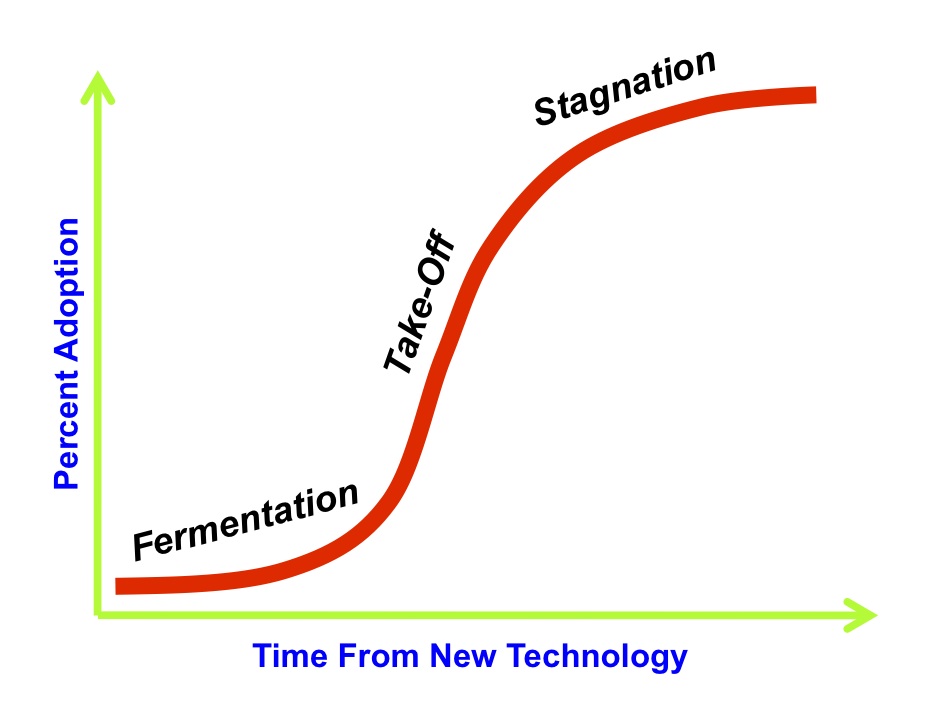 The fermentation stage is where the first product or service gets test marketed and finally sold. Once it's clear the product or service can fulfill a legitimate demand, production goes up and there is usually an attempt to reduce costs. Some improvement attempts, such as buying component parts in larger quantities which can be produced and shipped with more efficient methods, will reduce unit cost without reducing the quality of the product. Some statistical based production methods, that can only be employed with large production quantities, may even improve the quality further. As the market gets saturated and competitors enter the market, the "stagnation" stage starts. At this point, the product or service is usually "value engineered" to increase profitability at the cost of quality. For example, durable metal parts may be replaced by weaker or less precise plastic parts to match the price of competitors.
The next reason things can suck, which is to my knowledge has never been mentioned in business textbooks, is cultural. At the stagnation stage, the corporation has been accustomed to high growth and fat margins. So to keep operating, it needs a way to either increase revenue or lower costs. Perhaps debt servicing requires high growth or maybe management is just used to paying themselves well. If those expenditures cannot be reduced, management naturally then looks to reducing other costs and there's usually no larger cost than employees. It is at this point that employees try to justify their existence in some way. This is where the product enters what I would call the "improve it till it sucks" phase. Rather than be satisfied with offering products that do their essential job well, employees propose new non-essential features, sales gimmicks and "improved" interfaces to promise sales levels and cost levels that will keep management happy.

The number of ideas people come up with to keep their jobs is truly amazing. This is especially true if salaried positions are decoupled with sales results. When this is the case, the "customer" often becomes upper management rather than people outside the company. Perhaps this is why websites often introduce "new and improved" features that cannot be accessed by anything except the latest web browsers or newest mobile devices (often operated by management). Other changes may lead to shorter product life which may force upgrades or repeat sales in the short term. These changes, presented as "improvements", are what I would call the "keep your boss happy" product changes. They keep the boss happy but not the customer. This can be most easily seen in software where later versions either have feature encrustation or dumbed-down functionality in order to monetize a formerly free offering of features.
The customer can also be at fault too when it comes to demanding value from purchases. I suspect this is may be due to the cultural quest for seeking items that are "new" or "different" or it may just be due to declining per-capita wealth. Lack of demand for quality may also be due to the fracturing of traditional families which prevents high quality items from being passed down from generation to generation. This is not to say the demand for high quality items has vanished. Most people want items that perform well over many years. However, there is a significant risk to the customer for paying a premium for such items. It is all too tempting for a manufacturer to offer an item that appears higher quality, but really isn't. Perhaps all this is why, as my grandfather said, "You get what you pay for - only if you're lucky."
When it comes to the marketing cycle of products or services, most marketing text books show products tend to roughly follow an "S" curve similar to the one below.
The next reason things can suck, which is to my knowledge has never been mentioned in business textbooks, is cultural. At the stagnation stage, the corporation has been accustomed to high growth and fat margins. So to keep operating, it needs a way to either increase revenue or lower costs. Perhaps debt servicing requires high growth or maybe management is just used to paying themselves well. If those expenditures cannot be reduced, management naturally then looks to reducing other costs and there's usually no larger cost than employees. It is at this point that employees try to justify their existence in some way. This is where the product enters what I would call the "improve it till it sucks" phase. Rather than be satisfied with offering products that do their essential job well, employees propose new non-essential features, sales gimmicks and "improved" interfaces to promise sales levels and cost levels that will keep management happy.
The number of ideas people come up with to keep their jobs is truly amazing. This is especially true if salaried positions are decoupled with sales results. When this is the case, the "customer" often becomes upper management rather than people outside the company. Perhaps this is why websites often introduce "new and improved" features that cannot be accessed by anything except the latest web browsers or newest mobile devices (often operated by management). Other changes may lead to shorter product life which may force upgrades or repeat sales in the short term. These changes, presented as "improvements", are what I would call the "keep your boss happy" product changes. They keep the boss happy but not the customer. This can be most easily seen in software where later versions either have feature encrustation or dumbed-down functionality in order to monetize a formerly free offering of features.
The customer can also be at fault too when it comes to demanding value from purchases. I suspect this is may be due to the cultural quest for seeking items that are "new" or "different" or it may just be due to declining per-capita wealth. Lack of demand for quality may also be due to the fracturing of traditional families which prevents high quality items from being passed down from generation to generation. This is not to say the demand for high quality items has vanished. Most people want items that perform well over many years. However, there is a significant risk to the customer for paying a premium for such items. It is all too tempting for a manufacturer to offer an item that appears higher quality, but really isn't. Perhaps all this is why, as my grandfather said, "You get what you pay for - only if you're lucky."
Monday, November 12, 2012
Improve it till it sucks, why it happens - part one
A long time ago in a career far-far away, I was once asked this question by my electronics store sales manager... He first told me, "Look around. Look at all the items in this store. Why are these particular items here?" I looked at the various items in the store. There were quite a variety with each having some utility but with almost no common use that I could see.
 So, wondering where he was going with that question, I told him I had no idea. His reply was loud but direct, "THEY ARE HERE TO BE SOLD!". It was at that point when I finally truly understood the reasoning behind the apparent stupidity of some products. It now made sense why some of the higher priced radios sounded the same as the lower priced units with the only difference being that the higher priced unit had more functionally useless plastic parts stuck on them. It was the same reason some radios had excessive glowing lights, and LCD displays which looked high-tech but added virtually nothing to the music but were fetching higher prices than neighboring items on the shelf. I realized that the product designers simply wanted to maximize money. If it caused radios to become more ornate to sell better, so be it.
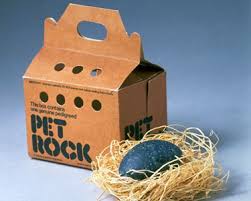
To multinational corporations, products are only useful as devices for which money is gathered. They have little sense of trying to make the world a better place. Rather, they are ultimately governed by stockholders and the legal requirement to make as high of a return for capital invested as possible. They care not if they sell round radios, yellow airplanes or square apples. As long as the items make money they are considered a success! In extreme cases, if an item is useful, it's almost a side effect. In many cases, the requirement of being useful isn't needed at all. Witness a fad from the 1970s called the pet rock.
The next piece of the puzzle, which I have never seen mentioned in any textbook, is another reason why so much stuff tends to improve till it sucks. When taken with this posting, it explains much.
See part two.

To multinational corporations, products are only useful as devices for which money is gathered. They have little sense of trying to make the world a better place. Rather, they are ultimately governed by stockholders and the legal requirement to make as high of a return for capital invested as possible. They care not if they sell round radios, yellow airplanes or square apples. As long as the items make money they are considered a success! In extreme cases, if an item is useful, it's almost a side effect. In many cases, the requirement of being useful isn't needed at all. Witness a fad from the 1970s called the pet rock.
The next piece of the puzzle, which I have never seen mentioned in any textbook, is another reason why so much stuff tends to improve till it sucks. When taken with this posting, it explains much.
See part two.
Sunday, October 21, 2012
"Just stop it" - one of the better memes.
When it comes to ideas that address such issues as Peak Oil and Global Climate Change, it's often not so much about a few individuals coming up with profound ideas as it is about filtering memes. For those who don't know what a meme is, it's simply an idea or saying that propagates and multiplies in a similar way that a life form does. In fact there is a series that examines how memes propagate. But I digress.
I would like to concentrate on one particular meme that I suspect could be a solution to many of the social ills which manifest themselves during times of stress. I could not have had a better introduction to the concept than was expressed by Linda Easley of the blog site "The conflicted doomer".
"There are times when I look around at what’s going on in the world and feel certain that aliens have invaded us, sucked out the brains of much of the world’s religious population and replaced it with grape jelly or something while I was out working in the garden."
I would like to concentrate on one particular meme that I suspect could be a solution to many of the social ills which manifest themselves during times of stress. I could not have had a better introduction to the concept than was expressed by Linda Easley of the blog site "The conflicted doomer".
"There are times when I look around at what’s going on in the world and feel certain that aliens have invaded us, sucked out the brains of much of the world’s religious population and replaced it with grape jelly or something while I was out working in the garden."
In spite of many individuals apparently undergoing this transformation as we experience the transformation of traditional industrial civilization, there is hope. One of the solutions to address the temporary stupidity afflicting some individuals, especially during elections, is the "Just stop it" meme. Hopefully, that meme will gain in popularity just as the various resource and environmental depletion memes have done.
Tuesday, August 28, 2012
Shouting at the wind.
 There is a phenomena that I call shouting at the wind. That is, saying how things should be but not doing any action to bring it about. It seems to be a national past time. Go ahead, try it. Go to your window and shout something such as, "I'm mad as hell and I'm not going to take it anymore!" Go ahead or don't. The result will be nearly the same. The action of ranting about how things should be can be by shouting or more quietly through blog writing as I'm doing now.
When it comes to really changing the world, it takes really good marketing of an idea.I say marketing since many people simultaneously may think of an idea but only a few make a living prognosticating an idea to the extent that it can truly change behavior. For example, in the peak oil world, James Kunstler's "end of suburbia" has caused some people to consider energy issues very seriously. It even changed my behavior such that I have moved to a semi-rural area that has good soil, good water and low-energy transportation in the form of a walkable community. There is just one major problem. There aren't too many jobs where I live....or are there?
Although I might be able to get a regular job where I live, there apparently is a larger opportunity earning money shouting at the wind - or better yet, shouting at an audience! For example, there is story about an engineer who produced wood gassifiers. The technology for energy production can convert wood to electricity. It has lots of potential but it tends to be very fussy, dirty, dangerous and expensive. Yet this engineer created a company and started producing some gassifier units. After a few years of doing that and failing to become filthy rich, he changed course. He took his knowledge of building them and started writing books and doing speaking engagements to tell about his problems encountered. When asked why he let his research stagnate rather than commercializing it, he was credited with saying, "There's lots more money talking about gassifiers than building them."
This pattern of describing a problem to the nth degree and then glossing over simplistic solutions is done over and over. Why does this work? Why are we suckered into going to theaters to see movies such as An Inconvenient Truth? The answer is simple. It's because imagining the benefits of doing any particular task is frequently more satisfying than getting one's hands dirty doing a task.
Wednesday, August 15, 2012
Stockpile if you must, but consider that gold has only one use...
When it comes to SHTF buying power, witness what happens in post-hurricane zones. Gasoline and food have more buying power than gold. So, in my opinion, instead of waiting for someone to make off with your precious gold bars during a crisis, cash it in now and start a business instead. With almost any product or service, if you focus on quality, you'll have a market since there will always be people who want the best. It could be the best beer, the best donuts or even the best buggy whips. In the past, I have been constantly amazed at how people make money in the strangest of markets - and that was before the Internet!. As an individual, having the ability to produce the best of most anything can mean making a living serving the tiniest of niche markets. Then, if you wish, you can trade your skills for gold..
If you decide you absolutely must have gold in spite of it's inflated price, consider this article.
http://shtfschool.com/category/trading/
Sunday, August 5, 2012
An unconventional tactic to combat Global Warming
 Bill McKibben, one of the most visible celebrities of the Global Warming movement, has written a rather sobering article about how much fossil fuels can be burned before the planet climate changes enough to endanger worldwide human civilization. Unfortunately, his view and mine seem to agree. We'll run out of environment before we run out of fossil fuels.
One number, roughly 565 Gigatons of carbon dioxide, is the tonnage of CO2 that can be put atmosphere by mid-century to have only a 2 degree increase in temperature. Such an increase would still lead to numerous climate disasters but human civilization might just survive in a recognizable form. Keep in mind this summer's disasters were only due to a half-degree increase. However, a much larger number, 2,795 Gigatons, is the amount of carbon that the coal, oil and natural gas industries have in projected reserves. That would lead to a 6 degree increase in temperature which is enough to end much of agriculture as we know it.
From the article in Rolling Stones Magazine:
Here's why this new number, 2795, is such a big deal. Think of two degrees Celsius as the legal drinking limit – equivalent to the 0.08 blood-alcohol level below which you might get away with driving home. The 565 Gigatons is how many drinks you could have and still stay below that limit – the six beers, say, you might consume in an evening. And the 2,795 Gigatons? That's the three 12-packs the fossil-fuel industry has on the table, already opened and ready to pour....Yes, this coal and gas and oil is still technically in the soil. But it's already economically above ground – it's figured into share prices, companies are borrowing money against it, nations are basing their budgets on the presumed returns from their patrimony.
 Now, supposing this article is even close to being correct, we're all in big trouble! Crafting legislation to encourage leaving the products in the ground apparently cannot be done without destroying the conventional economy. Put it another way, if the economic system was represented as a little kid and fossil fuel was represented as candy in front of him, telling him to only eat 20% and keep the rest in a clear jar next to his bed would not be an effective long term strategy for thwarting candy consumption. So, in my opinion, expecting sociopathic companies to be told to just ignore fossil fuel reserves would be an equally ineffective long term strategy. Worldwide government action to enforce carbon quotas also isn't likely since there are very large incentives to cheat the system. For example, sequestering CO2 gas at an industrial scale is doomed to failure for corruption reasons explained in my previous article HERE.
So, what can we do? In my opinion, the problem is now beyond governments to control. The only force now strong enough to save the climate is the power of entropy. Our economic system is set to extract hydrocarbons. The business plans cannot be stopped. However, the use of hydrocarbons can be diverted from uses that would release carbon dioxide gas to uses that would return these hydrocarbons to the ground.
How? One of the easiest ways to do this on a massive level would be to simply stop recycling plastic trash and stop burning plastic garbage for energy. Instead, encourage a culture of demanding throw-away hard to break down products and bury these used items in dispersed landfills. By itself, this type of carbon sequestration will not divert enough newly extracted carbon from being used as fuels. However, this combined with other carbon reducing steps may divert extracted hydrocarbons from atmospheric release to being returned to the ground. It's an icky gross solution. However, it's effective for insuring that this carbon is not able to be put to additional industrial use.
As a person who cares for the environment, it pains me to suggest this throw away strategy. Adopting a move towards a throw away society is not an obvious win. However, increasing household refuse production seems to be one of the only types of effective activism left to a population that has apparently been mentally crippled by industrial propaganda and demoralized by ineffective protest methods. Fortunately, I'm pretty sure that increasing solid waste is an activity that even the most apathetic of humans can do regardless of intelligence or political affiliation.
Don't believe the seriousness of the Climate Change problem? Judge for yourself:
Read more: http://www.rollingstone.com/politics/news/global-warmings-terrifying-new-math-20120719#ixzz22i9l2qRV
Other benefits to this unconventional tactic to combat Global Warming. Check:
Pen-and-Teller's series called - Bullshit
To track just how much the temperature across the country is increasing, check this out.
Don't believe the seriousness of the Climate Change problem? Judge for yourself:
Read more: http://www.rollingstone.com/politics/news/global-warmings-terrifying-new-math-20120719#ixzz22i9l2qRV
Other benefits to this unconventional tactic to combat Global Warming. Check:
Pen-and-Teller's series called - Bullshit
To track just how much the temperature across the country is increasing, check this out.
Monday, July 9, 2012
Defeating the garden predators
I  had a unique garden pest today. It was of the two legged kind. It picked all my tomatoes (even though they were green) and picked a good portion of the leaves off of my beans. Yet my other plants seemed to have survived. I suspect it was only innocent fun by a kid. Still, it got me to thinking of non-lethal garden defenses that could be used if I really became dependent on the food I will be growing in the years ahead.
In my opinion, the best garden defense is diversity. That is, to plant a variety of plants so if one plant succumbs to a threat, the others of a different type may survive. This has been particularly effective when it comes to bug defense. For example, beans in one part of my garden have mites but other distant bean plants developed no such problem. The same is true of the mysterious leaf hole phenomena that has eaten some of the cauliflower plants but has yet to spread to the others. It even helped with the two legged tomato raider who picked the really large tomatoes but left some of the smaller cherry tomatoes on the other side of the garden.
When it comes to theft, I tend to go for discouragement rather than overt defense. I have a saying. In any given Walmart parking lot, there is one car with a million dollars in the trunk and another with a body in the trunk. The only reason we don't know which is which is that nobody bothers to check.
Keeping that in mind, I find that defense through obscurity seems to work. My surface tomatoes were harvested but the tasty ground hugging cucumbers and underground radishes seemed to have survived intact. The lettuce, lacking any interesting fruit like features also survived.
Still, I realize that locks, doors and even barbed wire also have their place for stopping the larger pests. This chap has the look that is rather representative of the type I'm talking about. Since such zombie like beings can't be conveniently killed in our present legal system, I'm considering some non-lethal options. For the small ones, a sensible 6 foot fence to obscure garden goodies should be sufficient. For those who are ambitious enough to climb fences, some prickly rose bushes may discourage frequent repeat visits.
Thursday, July 5, 2012
Simplification rather than innovation
 There is a good video series by Dr. Joseph Tainer on the collapse of complex societies. There is a belief that innovation will solve problems of sustainability. The video exposes the myth that innovation and technology by themselves will be able to somehow overcome Malthusian limits. Also, technical solutions that provide less expensive benefits may simply be a way of exhausting resources quicker.
The talk is available via YouTube.
Subscribe to:
Posts (Atom)